
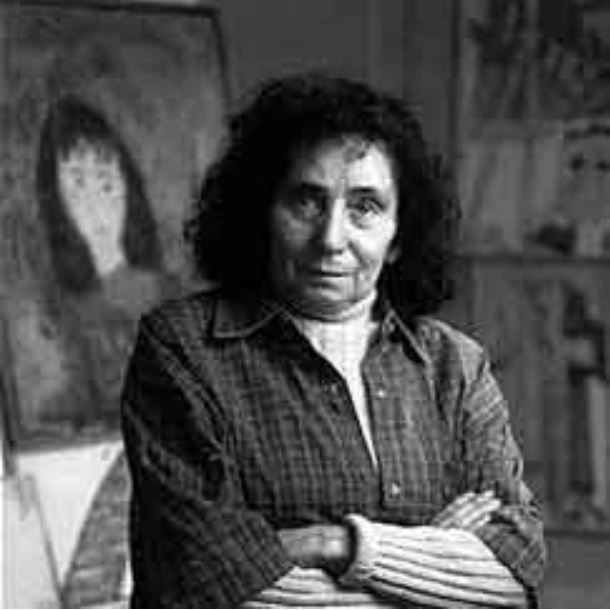
Lika Yanko (1928-2001)
What happened in Bulgaria after the Second World War was a sad and greedy example of a series of unfortunate events. A hermetically sealed model of a communist state is formed. The impressively well-crushed repressive machine crush ferociously the bond between West European and Bulgarian contemporary art. The rules of harsh academicism sit above every realization of creative thought. Times like these have created little artists like Likha Yanko. She is a rebel and a visionary of her time.
Lika Yanko was born March 19, 1928. in Sofia, 45th century “Rakovski”, a family of Albanian immigrants who are already parents of her older brother and sister. The reason why she did not appear in Albania, Grabova is the special destiny of her father, dictated by local manners and habits. Her father’s cousin (Lazar Yanko) was killed and retribution in the name of family honor is inevitable. It is her father’s duty to avenge what she has done. This is the case, and this necessitates the relocation of the young family in Sofia.
Lika grew happily, from 1935 to 1946. studied at the French college in Sofia called Saint-Joseph. In its library, she has seen numerous albums by French artists such as Gaggen, Mane and Cézan, who later will be considered her inspirational. She also loves the French poets, mostly the symbolists, led by Rembo. In September 1946, he began his studies at the Art Academy in the studio of professor Ilia Petrov, here begins the realization of a young artist, how much he is free in his most personal – his work. In contrast to Russia, where, although the avant-garde for a short time meets the approval of the state authorities, in Bulgaria it is only “ethno-native copy” that is “appropriate”. What she demands is in complete harmony with her ideas. 1952 graduated with a diploma thesis named Tractorists, valued at 3.00. In 1960 she participated in the “Exhibition of Women”, Vera Nedkova, with whom she is known, is part of the jury advocates for her. In the same year began the visits of Yanko in the Rhodope Mountains, where he created much of his most iconic landscapes. In the summer of 1961 was her first creative visit to Sozopol and until 1987 she spent every summer there. In the following years, the artist participated in several other exhibitions, and in 1967 the sad January came to an end, in which her first solo exhibition ended in unbelievably 7 days. Yanko is supported by various types of work. In 1975, diplomats from Western embassies began buying paintings, and in 1981, the first and “full-scale” solo exhibition took place. Up to his death in 2000. Lika Yanko does not stop creating and bequeathing art filled with tenderness, freedom and spirituality, in which the non-conventional materials she uses are the conductor between the world of Lika and ours.
)